

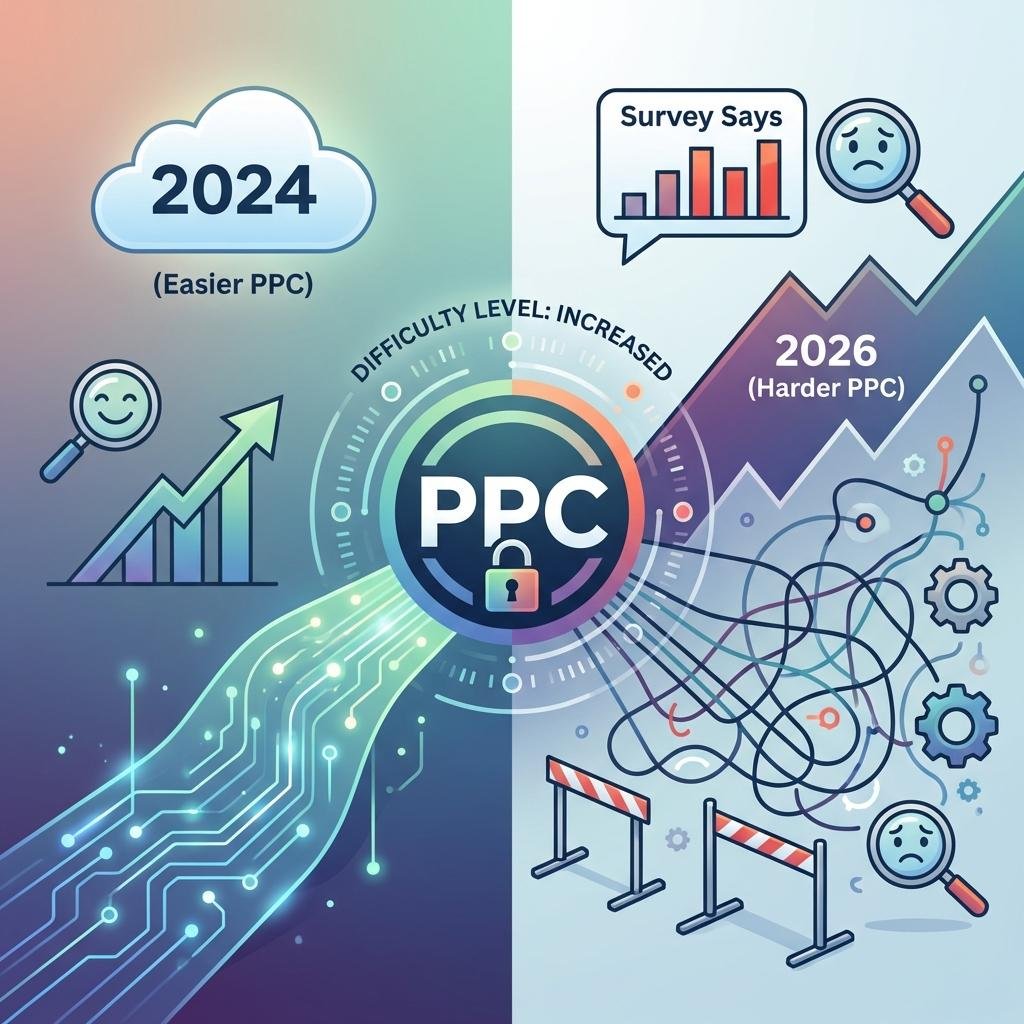
Arecent industry-wide survey confirms what digital marketers have been feeling in the trenches: PPC is significantly harder in 2026 than it was just two years ago.
Between skyrocketing cost-per-clicks (CPCs), the complete phase-out of third-party cookies, and relentless AI-automated bidding wars, the traditional pay-to-play model is hitting a wall of diminishing returns. As paid landscapes become increasingly volatile and expensive, marketing leaders are urgently shifting their focus back to organic growth.
However, an effective SEO strategy in 2026 looks vastly different than it did in the past. It is no longer about reverse-engineering blue links; it is about mastering Generative Engine Optimization (GEO) and demonstrating undeniable human authority.
Here is why the pivot to organic is happening—and how to future-proof your SEO strategy for the rest of 2026.
The 2026 PPC Crunch: Why Paid Search is Losing Its Edge
The recent data highlighting the rising difficulty of PPC points to three structural pain points that are squeezing marketing margins:
Privacy-First Attribution Gaps
Without granular third-party tracking, measuring the direct return on ad spend (ROAS) has become incredibly opaque. Marketers are bleeding budget on campaigns with unverified impacts.
AI Bidding Saturation
Widespread adoption of algorithmic bidding has leveled the playing field. Finding "cheap" gaps or inefficiencies in the auction is nearly impossible when every competitor relies on the same machine-learning platforms.
Severe Ad Blindness in the AI Era
In response to these compounding challenges, savvy brands are reallocating ad spend into sophisticated, multi-channel SEO frameworks.
The 2026 SEO Blueprint: Beyond the Traditional SERP
To capture market share today, your organic strategy must align with the latest shifts in search behavior, LLM (Large Language Model) integration, and algorithm updates.
1. Generative Engine Optimization (GEO)
Search engines have fully evolved into “Answer Engines.” Your content must be optimized to serve as the primary foundational source for AI-generated overviews. Winning in GEO requires:
- Direct Answer Formatting: Structure your data with clear, concise headers and bulleted lists that AI agents can effortlessly parse and extract.
- Aggressive Citation Building: Ensure your brand and entities are mentioned across authoritative, high-trust platforms so LLMs recognize you as the factual consensus for your niche.
2. Elevating E-E-A-T with First-Party Data
In an internet flooded with commoditized, AI-generated text, Experience, Expertise, Authoritativeness, and Trustworthiness (E-E-A-T) are the definitive ranking differentiators.
- First-Party Data SEO: Leverage your own internal studies, proprietary surveys, and unique customer insights. Create data-rich content that AI cannot scrape, hallucinate, or replicate.
- Human Author Signals: Anonymous “staff” bylines no longer rank. Search algorithms heavily weight content authored by verified experts with established digital footprints and active industry profiles.
3. Conversational Intent & AI Voice Search
4. Video SEO and Visual Search Dominance
The 2026 SERP is a highly visual, multimodal experience. Short-form video content is now a core pillar of organic search. If your strategy does not include indexed, optimized video clips that directly answer specific user queries, you are forfeiting up to 40% of modern search real estate.
Maximizing Organic ROI: Actionable Steps for Q2 2026
Key Action Items to Implement Immediately:
Conduct an AI Visibility Audit
Analyze whether your site is being cited in AI overviews (like Google's AI Overviews or Perplexity). If not, overhaul your technical SEO and schema markup for better LLM crawlability.
Inject "Experience" into Legacy Content
Optimize for Zero-Friction Conversions
The Bottom Line
The sentiment that “PPC is harder” is not a temporary fluctuation—it is a permanent structural shift in digital marketing. As we navigate the complexities of 2026, the brands that dominate their industries will not be the ones with the deepest ad pockets. They will be the ones that own their audience through high-authority, human-centric, and AI-ready organic content.