It is a common misconception that AI will kill SEO. In reality, SEO is evolving from a keyword-matching discipline into a data-readability discipline — and that distinction changes everything.
Think of SEO as the foundation of a building. AIO, AEO, and GEO are simply the upper floors and advanced infrastructure being added on top. Without the foundation, the upper floors collapse.
Without the foundation (SEO), the upper floors collapse. AI hasn't removed the need for structure — it has raised the stakes for it.
— Search Strategy DeskThe Architecture
Why It's an Upgrade, Not a Replacement
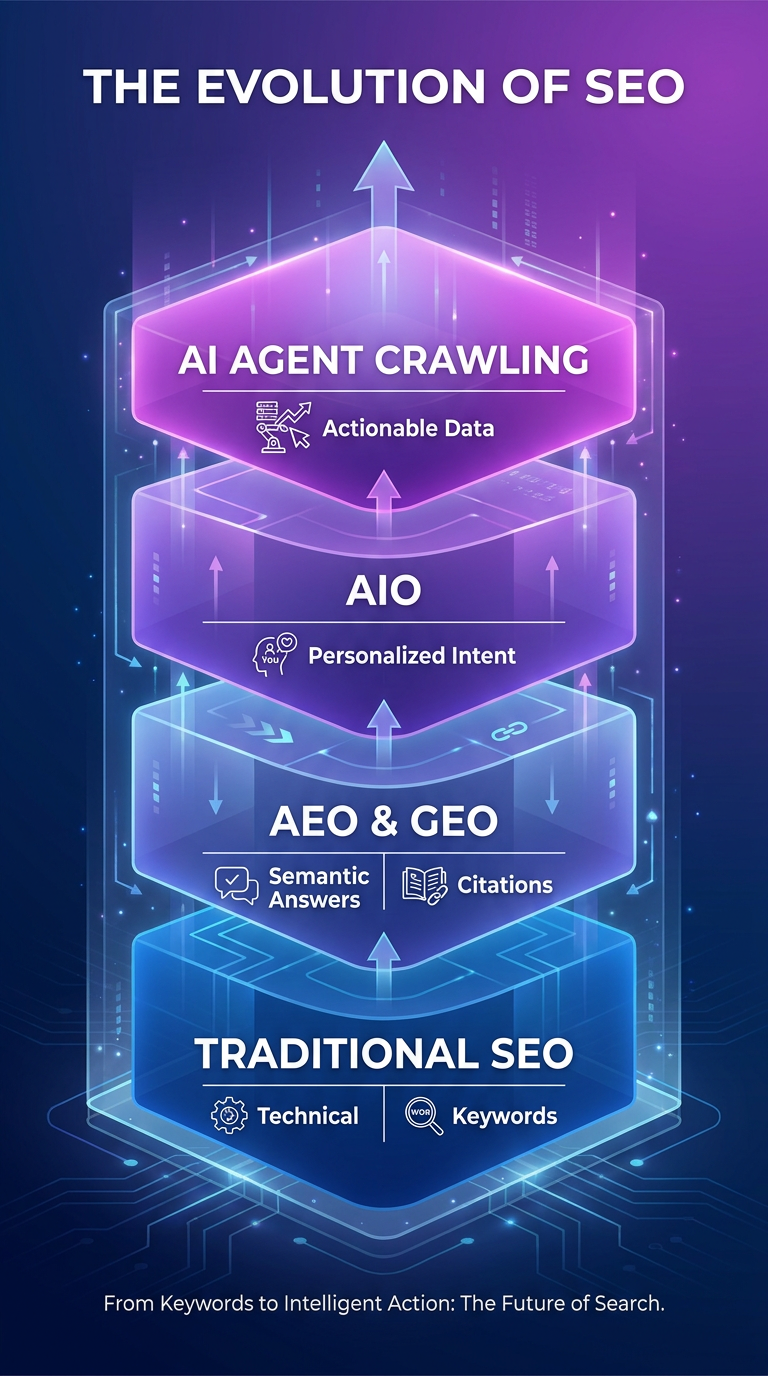
Layer 01
Traditional SEOThe Foundation
Role: Technical health, site speed & domain authority
If your site doesn't load fast or isn't crawlable, an AI agent cannot "read" it to recommend it. LLMs prioritize sources with high authority and clean code. This layer isn't threatened by AI — it's required by it.
Actions to take
- Run a Core Web Vitals audit (PageSpeed Insights) and target LCP under 2.5s — slow pages are deprioritized by both Google and LLM crawlers.
- Submit an updated XML sitemap to Search Console and audit your robots.txt to ensure no key content is accidentally blocked from crawlers.
- Build topical authority through a strategic internal linking structure — cluster related content around pillar pages to signal expertise to LLMs.
Layer 02
AEO & GEOThe Semantic Layer
AEO: Answer Engine Optimization · GEO: Generative Engine Optimization
AEO is optimizing for direct answers in tools like Perplexity or ChatGPT. GEO is optimizing for citations in generative search environments like Google SGE.
This moves beyond keywords to entities and facts. You aren't just trying to rank #1 — you are trying to be the source that the AI cites when it answers a question.
Actions to take
- Restructure key content pages with a concise Q&A section at the top — direct, factual answers to common queries are what Perplexity and ChatGPT pull as citations.
- Implement FAQ and HowTo schema markup (JSON-LD) so generative search engines can extract structured facts without scraping raw prose.
- Earn citations on authoritative third-party sources (industry publications, Wikipedia, government sites) — GEO rewards entities that appear consistently across the web, not just on your own domain.
Layer 03
AIOThe Intelligence Layer
Role: Using AI tools to predict user intent & personalize content
SEOs now use AI to analyze massive datasets to understand why users are searching, not just what they are searching. It allows for dynamic content that evolves based on the user's journey — a fundamental shift from static keyword targeting.
Actions to take
- Use AI tools (e.g. Surfer SEO, MarketMuse, or a custom GPT prompt on your Search Console data) to cluster queries by intent stage — awareness, consideration, decision — and map content gaps.
- Introduce dynamic content modules on high-traffic pages that adapt CTAs or featured content based on UTM source or referral channel — aligning copy to where the user came from.
- Feed your top-performing blog posts into an LLM to identify recurring semantic themes and sub-topics you haven't covered — then build those content assets before competitors do.
Layer 04
AI Agent CrawlingThe Action Layer
Role: Optimizing for autonomous agents that perform tasks
This is the highest level of SEO. Instead of just "reading" your text, an agent needs to interact with your site. This requires advanced Schema Markup (JSON-LD) and API-like data structures so an agent can book a flight or buy a product directly from your page — without a human clicking a button.
Optimizing for agents like future Siri or Google Assistant isn't a future concern. It is the frontier that top technical SEOs are navigating right now.
Actions to take
- Implement rich JSON-LD schema for every transactional element on your site — Product, Offer, Event, LocalBusiness — so agents can extract structured data and act on it without human interaction.
- Expose a public-facing API or data feed (even a simple RSS or JSON endpoint) for your core content — agents prioritize machine-readable sources over scraping HTML.
- Audit your site's interaction flows (booking, checkout, form submission) for agent compatibility — ensure critical actions don't rely on JavaScript-only renderings that headless crawlers cannot execute.
The Core Principle
The "What Goes In Determines What Comes Out" Rule
AI models are trained on the web. If you stop doing SEO, your data becomes messy, your authority drops, and your technical structure fails. As a result, AI engines will stop including you in their answers.
SEO is now the Translator that makes your brand's data understandable for the world's most powerful AI engines. Neglect it, and you become invisible to the very systems your customers are querying.
Research Deep Dive · 2025–2026
What the Data Actually Says
The claim circulating among top practitioners is real — and now backed by large-scale studies. Publishing on high-authority external platforms doesn't just boost traditional rankings; it is the primary mechanism by which AI engines learn to trust, mention, and cite your brand. Here is what the numbers confirm.
The Mechanism
The "Consensus Signal" AI Engines Look For
AI platforms don't cite brands they've only heard from once. Research from Profound and SEMrush shows that AI systems scan for agreement across multiple independent sources before confidently recommending a brand. A mention in a Reddit thread, a G2 review, a YouTube tutorial, and an industry publication — all saying the same thing about your brand — creates the consensus signal that triggers citations. One source on your own website creates nothing but skepticism.
As Ahrefs' Director of Content, Ryan Law, put it directly: "The content on your own site isn't as valuable as the content about you on other pages on the web." Ahrefs CMO Tim Soulo went further, calling third-party citations "the new backlinks" for the AI era.
Platform Intelligence
Where Each AI Engine Goes to Find You
Each platform has distinct source preferences. Only 11% of domains are cited by both ChatGPT and Perplexity. Google AI Overviews and AI Mode share just 13.7% of their citations. A one-platform strategy leaves most of your potential AI visibility on the table.
Synthesised from 12+ studies · 2025–2026
7 Common Points That Drive AI Citations Fastest
Across all the research — Ahrefs, Profound, SEMrush, BrightEdge, Cyrus Shepard's citation factor analysis, and practitioner data — these are the signals that appear consistently as the fastest levers to pull.
Publish on platforms AI already trusts — Reddit, LinkedIn, Medium, Quora
Reddit appears in 37% of all Google searches in the top 10 and accounts for 44% of social-media AI Overview citations. LinkedIn is the most-cited domain for professional queries across ChatGPT, Perplexity, AI Mode, and Copilot. Publishing genuinely helpful, expert-level content on these platforms borrows years of trust your own domain hasn't accumulated yet. White-hat rules apply: AI models and platform moderators filter promotional noise fast.
Get your brand into YouTube — transcripts are indexed and weighted at 0.737 correlation
YouTube mentions are the single strongest signal for AI brand visibility in the Ahrefs 75,000-brand study — outperforming backlinks, domain rating, and content volume. YouTube is cited in 23% of AI Overview responses and ranks among the top mentioned domains in Perplexity. AI models read video transcripts. A mention in a well-watched industry tutorial carries a signal equivalent to a tier-1 editorial placement. Getting reviewed, compared, or name-dropped in video content is now a core SEO activity.
Earn tier-1 media placements — earned media drives 48% of AI brand citations
When ChatGPT or Perplexity recommends a brand, they cite publications that have independently verified that brand's claims. Clients with consistent earned media coverage in publications like TechCrunch, Forbes, and industry journals see 4.7× more AI citations than those relying on owned content alone. Every tier-1 placement becomes training data that AI models use to assess your authority. PRnewswire and Forbes were the biggest winners in ChatGPT citation growth in late 2025.
Build review platform presence — G2, Trustpilot, Capterra cited 3× more by AI models
Brands with positive presence on platforms like G2, Trustpilot, and Capterra are cited 3× more frequently by AI models. G2 is the most-cited software review platform across ChatGPT, Perplexity, and Google AI Overviews. This is the "mention-source divide" in action: AI recommends your brand in the answer text, but cites G2 as the source link. Claiming, optimizing, and earning reviews on these platforms is direct AI citation infrastructure.
Front-load every page — 44.2% of LLM citations come from the first 30% of content
AI systems don't favor pages that require scrolling for the answer — they favor pages that front-load it. Analysis of AI citation patterns found that 44.2% of all LLM citations are extracted from the first 30% of page content. Structure every page with a direct 40–60 word answer in the opening paragraph, followed by supporting detail. Pages with First Contentful Paint under 0.4 seconds average 6.7 citations; slower pages drop to 2.1. Speed and structure are inseparable.
Maintain freshness signals — content updated in the past 3 months averages 6 citations vs 3.6 for stale pages
A page last updated in 2022 is less likely to be cited in AI search than one updated recently — even if the 2022 page ranks higher in traditional search. Content updated within three months averages 6 citations versus 3.6 for outdated pages. Add a "Last Updated" date using dateModified schema markup. AI Overviews change 70% of the time for the same query, and 45.5% of citations get replaced when a new answer is generated — recency is how you stay in the rotation.
Allow AI crawlers — blocking GPTBot or PerplexityBot guarantees invisibility
Blocking GPTBot, ClaudeBot, and PerplexityBot in your robots.txt means you categorically cannot be cited in those engines — regardless of how well your content is structured or how many external mentions you've earned. Allowing AI crawlers is now standard practice. Simultaneously, ensure Bing Webmaster Tools is set up: ChatGPT's live web retrieval uses Bing's index as its primary data source, meaning brands invisible on Bing are invisible to ChatGPT's real-time search regardless of their Google rankings.
The Strategic Takeaway
Authority-Led SEO Is Not a Hack — It’s How AI Learns to Trust Your Brand
Publishing expert-level, genuinely useful content on platforms AI already trusts — Reddit, LinkedIn, YouTube, G2, Wikipedia — is the legitimate, durable mechanism for building AI visibility. Black-hat parasite pages (spam, thin content, unrelated niches) now have a lifespan of 6–8 weeks before algorithmic removal. White-hat parasite SEO, built on real expertise and real platforms, compounds over time. The discipline isn't SEO anymore — it's what researchers are beginning to call Machine Relations: building the external web of credibility that AI engines use to decide who to trust.
Your brand's SEO foundation is the prerequisite for AI visibility. The question isn't whether to invest in it — it's whether your current structure can support the layers being built on top.